
'Civilian casualties are something that could change the mood overnight, and therefore should be avoided by every means.'

Unlike in the past, Modi made candid, frank and direct remarks on his hosts by suggesting that the Chinese side is holding back on further improving relations, says Srikanth Kondapalli.

As fuel prices continue its northward march with petrol and diesel being sold at Rs 80.73 and Rs 72.83 per litre in the national capital, at least 21 opposition parties, led by the Congress have staged a Bharat Bandh protesting the rise in fuel prices and depreciation of the rupee.

'Galbraith had a powerful ally in Washington -- not as blunt and direct as the ambassador -- but committed to see Krishna Menon go.' 'This was President Kennedy himself.'

Each city would get Rs 100 crore (Rs 1 billion) every year.
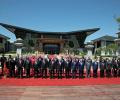
'Whichever option India chooses, it should be clear to the government that the China-Pakistan nexus poses a clear and present danger to national security,' says Brigadier Gurmeet Kanwal (retd).

'The prime minister expressed concern and assured all possible help to the state,' CMO said.

From lining up allies to having them accept him as the Opposition's prime ministerial candidate in the 2019 Lok Sabha elections, Congress president Rahul Gandhi's real challenge has just begun, says N Sathiya Moorthy.

'During his visit to Vietnam on September 3 -- the first visit by an Indian prime minister in 15 years -- Modi will notice the widespread anti-China sentiment in that country.'

India and Japan have a shared interest in countervailing China's hegemonic ambitions in Asia. Although neither has an interest in forming an overt anti-China alliance, Tokyo and New Delhi feel increasingly obligated to work together to find ways to guard against a muscular Beijing's power sliding into arrogance, says Brahma Chellaney.

The allocation in the defence budget is inadequate to meet India's long-term threats, especially from China and Pakistan, says Gurmeet Kanwal.

'The question remains: Was the Obama visit truly a success? Only the future will tell us if the "breakthrough" in the nuclear liability issue will concretise into electricity.' 'As importantly, it will be interesting to watch how India's relations with China will evolve in the months to come.'

'Pakistan needs to be constantly at war with somebody, ultimately resulting in it waging war on itself and its own people,' says Shekhar Gupta.

Vietnam is a key player in India's act east policy under Prime Minister Narendra Modi. From India's perspective, a strategic partnership with Vietnam will only deepen political, economic, and security ties and be a bulwark against China, say Melissa S Hersh and Dr Ajey Lele

The bravado of NDA ministers may have undone the gains made in cross-border security cooperation over the past several years.

'Pakistan's recent utterances and tendency to use pinpricks to try our patience appear reminiscent of 1965. We are a strong nation, emerging stronger,' says Lieutenant General Syed Ata Hasnain (retd).

'I believe Modi mentioned Balochistan only to embarrass Pakistan and also divert attention toward the situation in Kashmir.' 'I think from now on, India intends to raise Balochistan whenever Pakistan brings up Kashmir or upsets them on the issue of terrorism.' 'Balochistan is the least developed of Pakistan's four provinces. It is the least educated and least economically developed. People are agitated that a region so rich in mineral resources and a sea-port is still so poor.' Baloch political analyst Malik Siraj Akbar on why the province wants freedom from Pakistan.

At the moment, data and broadband is small for BSNL: it contributes 10 per cent of the company's revenue, though its share is on the rise.

AAI has 51% stake in the project while Punjab and Haryana have 24.5% equity each.

'It was a mission undertaken in darkness in every sense -- literally, because Afghanistan had no electricity at that time; and, metaphorically because Delhi historically dealt only with the Pashtuns of Afghanistan and the foreign ministry's vast archives had nothing to offer on the culture and politics of the northern tribes in the Hindu Kush.'

If the AAP wins 20 to 40 Lok Sabha seats, which is conceivable unless it botches up on governance in Delhi, it will become a significant bloc comparable in influence to or even bigger than several major regional parties, feels Praful Bidwai.

One of Indian TV's most famous faces tells Kanika Datta why and how she hopes to reinvent herself in the uncharted territories of multimedia and think tanks

'Attempts at long-term rapprochement have been rather feeble from both sides. The primary cause of the lack of progress is that these efforts do not appear to have the support of the Pakistan army,' says Brigadier Gurmeet Kanwal (retd).
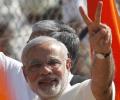
With Narendra Modi about to make his first Independence Day speech, there is a buzz in Delhi that Modi will make some big announcements to signal major reforms and directional shifts. But we have to wait and see if it happens, says Mohan Guruswamy.
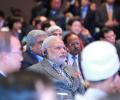
After one year in power, Prime Minister Narendra Modi is pretty much on the back foot, even if he continues to display bravado in his public pronouncements. He knows within his heart that he has wasted a lot of his political capital without getting much in return, says M K Venu.

In the light of the efforts being made to forge electoral unity between scheduled castes and Muslims, Mohammad Sajjad examines what the architect of our Constitution, B R Ambedkar, had to say about the Muslim community.

Now that Tamil Nadu's tallest politician is no more, it remains to be seen how new political re-alignments could shape up, says N Sathiya Moorthy.

'Chinese leaders rarely receive their foreign guests in cities other than Beijing. Such respect for India!' 'Does it mean that Modi could replicate "the warmth and unconventional way" by sending Indian troops into Tibet, as Xi did in Chumur (Ladakh) when he arrived in India? Of course, Indians are far too polite to do so,' says Claude Arpi.

'There is tension between the zones all the time.'

Terrorism and Afghanistan were the focus points of Prime Minister Narendra Modi's talks with Uzbek President Islam Karimov on his first visit to Central Asia.

New Delhi and Beijing are the only two regional capitals that have commented on US President Donald Trump's speech on August 21 outlining the way forward in Afghanistan. The Indian foreign ministry statement was effusive in praise, while the Chinese statement has been one of cautious and guarded hope. Delhi has identified itself with Trump's Afghan strategy, whereas the Chinese stance is calibrated -- observant and objective, keeping a distance, says Ambassador M K Bhadrakumar.

Those who know Shiv Shankar Menon will vouch that he did lots of things, substantial in the immediate neighbourhood and widespread in South Asia, but without making things public. Twenty per cent of Menon's job was visible, while 80 per cemt of his job was not known to the public, says Sheela Bhatt/Rediff.com

'The Pakistan government, we were told, has a plan to renovate several Hindu temples and Buddhist sites, which over the years have fallen into disrepair. The aim is to create a pilgrimage circuit to attract visitors from all over the subcontinent.'
'Parties like ours and others like the Lok Janshatki Party will ensure that the BJP remains on the straight and narrow path,' says Shiromani Akali Dal leader Naresh Gujral

'The public has unfair expectations from Mrs Swaraj who is in Islamabad primarily for the Heart of Asia Conference. To restore India's position among stakeholders on Afghanistan is a fair one but to expect her to do more on the Indo-Pak front without requisite preparatory work is unrealistic.'

Bhutan's recognition of Bangladesh without waiting for Indian advice was a clever move, but if it did it even before India did, it was a calculated gamble to assert its independence, says T P Sreenivasan.

A sensational interview on India-China ties, with the man most qualified to answer.

Most expect these bubbles to break in short order and cause serious financial pain to anyone who's foolhardy enough to remain invested in financial assets.

The roots of the problem lies in the alienation of the tribals. Extreme sensitivity is required to tackle the issues involved. Rough and ready methods of using force may prove counterproductive in the long run, says Colonel (retd) Anil Athale.
